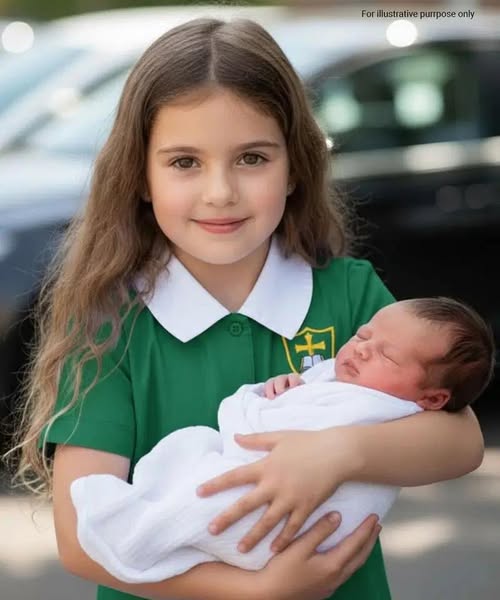
A poor girl, running late for school, finds an unconscious baby locked in a luxury car. She breaks the window and rushes the baby to the hospital. Upon arrival, the doctor falls to his knees, weeping.
The streets of Buenos Aires blazed under the relentless midday sun as Patricia Suárez, a young woman of just 16, ran desperately toward her school.
Her worn shoes pounded the pavement as she dodged passersby, knowing this would be her third tardy this week. The principal had made it clear: one more tardiness and she would have serious trouble keeping her scholarship.
“I can’t lose her,” she murmured between gasps, clutching the used books she had worked so hard to acquire to her chest. Her uniform, inherited from an older cousin, showed obvious signs of wear, but it was the best her family could afford. It was then, as she turned the corner onto Libertador Avenue, that she heard it.
At first, she thought it was her imagination, but the faint crying became clearer. It was coming from a black Mercedes parked in the blazing sun. Patricia stopped abruptly. Through the tinted windows, she made out a small figure in the back seat. The crying had faded to a faint whimper, barely audible. Without a second thought, she approached the vehicle. The car was sweltering, and there, in its car seat, a baby no more than six months old writhed weakly, its reddish skin glistening with sweat.
“Oh my God!” Patricia exclaimed, pounding on the window. She looked around for help, but the normally busy street seemed deserted. At that moment, The baby had stopped crying, and his movements were growing slower and slower. The decision was instantaneous. She grabbed a piece of rubble from the ground and, closing her eyes, smashed it against the back window. The glass shattered with a crash that seemed to echo throughout the street. The car alarms began to blare as Patricia, ignoring the cuts on her hands, reached through the broken window to grab the little one.
Her fingers trembled as she struggled with the car seat straps. The baby was barely responsive now, his eyes half-closed, his breathing shallow and rapid.
“Hang on, little one,” she whispered finally, freeing him.
She wrapped him in her own school jacket and, completely forgetting about school, her books scattered on the sidewalk, and the wrecked car, she ran toward the nearest hospital. The five blocks to San Lucas Clinic felt like the longest of her life. The weight of the baby in her arms seemed to increase with every step, while her lungs burned with the effort.
People moved aside as she passed, some shouting, others pointing, but Patricia could only focus on keeping pace, on not stumbling, on arriving on time. She burst into the emergency room like a storm, her uniform stained with sweat and blood from the cuts on her hands. “Help!” she cried, her voice breaking, “please, he’s in very bad shape.” The medical staff reacted immediately. A nurse took the baby from her arms as the doctors rushed to his aid. Amid the commotion, Patricia watched as one of the doctors, a middle-aged man, approached the little boy.
The doctor’s reaction was instantaneous. His knees buckled, and he had to lean on a stretcher to keep from falling.
“Benjamin,” the doctor whispered, tears streaming down his cheeks. “My son.”

Patricia felt the world stop. The baby she had just rescued was the doctor’s son.
Questions began swirling in her mind, but before she could process what was happening, two police officers entered the emergency room.
“Patricia Suárez,” one of them asked, approaching with a stern expression.
“We need you to come with us. There are reports of vandalism and a possible kidnapping.”
The doctor, regaining his composure, stepped between Patricia and the officers.
His voice, though trembling, was firm.
“This young woman just saved a life.”
“My son, and I need to know exactly how he got in that car.”
The next few hours became a whirlwind of questioning and revelations. Patricia sat in a small office inside the hospital, her hands now bandaged, trembling around a glass of water she had barely touched.
In front of her, Dr. Daniel Acosta, little Benjamin’s father, listened to her story for the third time while the officers took notes.
“Then, I just heard the crying as I walked by.”
“What happened?” asked the youngest officer, Lucas Mendoza. His gaze was skeptical.
“Yes,” Patricia replied, her voice tired but firm. “The car was in the sun, all the windows closed, no one around. I tried to get help, but I stopped, remembering the desperation of that moment.”
Dr. Acosta ran a hand over his face, clearly exhausted.
His son was stable now, responding well to treatment for the hyperthermia, but the circumstances leading up to this situation were becoming increasingly murky.
“My wife, Elena, left Benjamin with the nanny this morning,” the doctor explained, his voice cracking slightly. “Teresa Morales has worked for us for three months, impeccable references. When I called home after she brought Benjamin in, no one answered.”
The officers exchanged meaningful glances.
The Mercedes was reported stolen an hour ago, Officer Mendoza informed them.
Mrs. Acosta arrived home to find the back door forced open. The nanny was gone, along with some jewelry and important documents. Patricia listened, trying to process all the information. The nanny had tried to kidnap the baby. Why abandon him in the car? Something didn’t add up. “Dr. Costa,” Patricia interrupted timidly, “may I ask you something?” When the doctor nodded, she continued. The car where I found Benjamin was locked from the inside, as if someone had wanted to make sure no one could get him out.
A heavy silence fell over the room. Dr. Acosta paled visibly. “The locks on my Mercedes are automatic,” he muttered, more to himself than to the others. “They can only be activated with the key or the remote,” Officer Mendoza added, pulling out his phone. “We need to review the security camera footage from the area. Now.” As the officers left the office, Dr. Acosta slumped in his chair, his face a mask of worry and confusion. “Patricia,” he said gently.
“There’s something I need to confess to you, something that might explain all of this.” Patricia straightened up in her seat, noticing the change in the doctor’s tone. “Two weeks ago,” he began, “I received an envelope at my office. It contained photographs—photographs of Benjamin, of Elena, of our daily routines—along with a note telling me to stay away from a certain medical case.” “A medical case?” Patricia asked, sensing they were entering deeper waters. “I’m a key witness in a medical malpractice case against a very prestigious private clinic.”
“My testimony could shut the place down.” The doctor stood up and began pacing nervously around the small office. “I thought I could handle it. We increased security. I hired Teresa after thorough background checks.” But now a knock on the door interrupted their conversation. It was a nurse, her expression worried. “Dr. Costa, your wife is here, and there’s something you need to see.” Elena Acosta was an elegant woman who, even in distress, maintained admirable composure. However, when she saw Patricia, something in her expression changed.

“You’re the young woman who saved my baby,” she asked, her voice breaking as she reached out to hug her. Patricia, surprised by the gesture, could only nod. But it was what Elena said next that made everyone in the room freeze. “Teresa is dead,” Elena announced, pulling away from the hug. “The police just found her body in the trunk of her own car, a few blocks from our house.” Dr. Acosta slumped in his chair, stunned.
“Dead! But how come there’s more?” Elena continued, pulling a crumpled envelope from her purse. They found this in her pocket. It’s documents about the clinic, about the negligence cases. It seems Teresa was investigating on her own. Patricia watched the exchange, the pieces beginning to fall into place in her mind. The Mercedes, she said suddenly, making everyone look at her. Why leave Benjamin in the doctor’s Mercedes? Why not any other car? Dr. Acosta jumped up, a new understanding dawning on his face, because they wanted it to seem like he’d forgotten.
“A doctor who testifies about negligence, being negligent with his own child, would have been found too late,” Elena whispered, horrified. “Your credibility would have been destroyed.” “And Teresa found out,” Patricia finished. That’s why another knock on the door interrupted the conversation. It was Officer Mendoza holding a tablet. “You need to see this,” he said, playing a security video. It clearly showed two men intercepting Teresa near the Acosta home, forcing her into a vehicle.
Minutes later, the doctor’s Mercedes pulled out of the garage, driven by one of them. “We’ve identified one of the suspects,” Mendoza reported. “He worked as a security guard at the clinic that’s under investigation.” Dr. Acosta took his wife’s hand, his face a mixture of pain and determination. “This goes beyond a simple case of negligence,” he said. “And thanks to you, Patricia, they didn’t achieve their goal.” Patricia looked at her bandaged hands, thinking about how a simple academic setback had put her at the center of something much bigger.
“What happens now?” she asked. “Now,” Officer Mendoza replied. “We need to keep everyone safe while we unravel this conspiracy.” Ya added, looking specifically at Patricia. “I think we should talk to your school about your absence today. After all, you saved a life.” Elena approached Patricia again, this time with a more serene expression. “You didn’t just save my son,” she said gently. “I think you’ve helped expose something that could save many more lives.” At that moment, as if to confirm his mother’s words, Benjamin’s crying was heard from the next room.
See Next Page To continue reading